Human + AI, Making AI real
My Role Is No Longer One Thing
And I'm starting to think that might be the point.
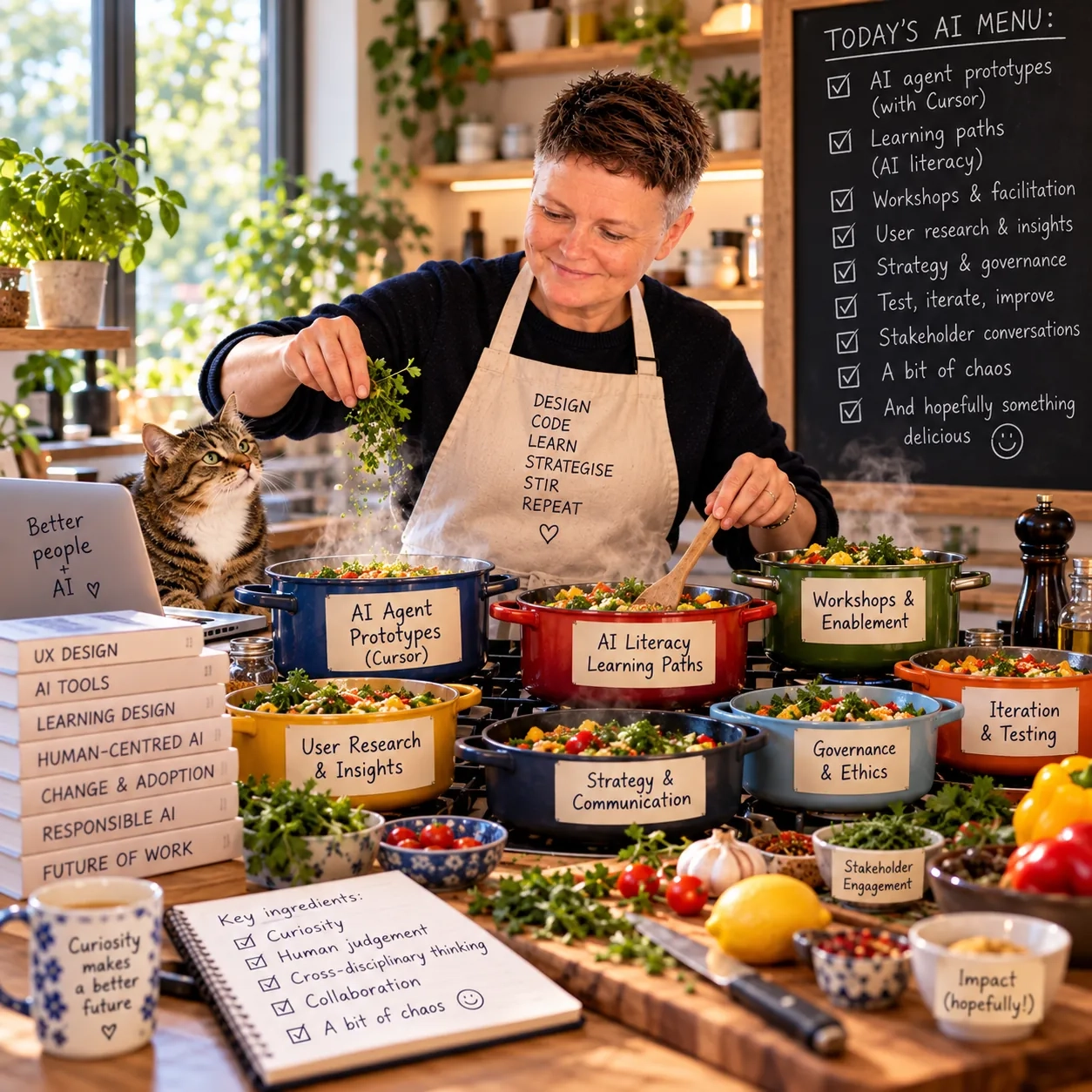
My role is no longer one thing.
And I’m starting to think that might be the point.
On one side, I’m using Cursor to create AI-agent prototypes and explore what increasingly autonomous experiences could look like.
On another, I’m thinking about AI literacy and learning pathways: how people in large organisations move from knowing that AI exists to actually being able to use it safely and meaningfully.
Then there are workshops.
Research.
Strategy.
Governance.
Communication.
Testing.
Stakeholder conversations.
UX.
Responsible AI.
Sometimes it feels like cooking several dishes at once.
For a long time, professional expertise was often described through specialisation.
You were the designer.
The developer.
The researcher.
The strategist.
The learning specialist.
AI is making those boundaries much more porous.
It lets us move faster between thinking and making.
I can research a problem, explore possible interventions, prototype something, test it and change direction without waiting for every stage to become a separate project.
But this creates an interesting paradox.
As AI expands what one person can do, the distinctly human part of the work becomes more important.
Curiosity.
Judgement.
Understanding people.
Knowing which question to ask.
Recognising when something doesn’t make sense.
Connecting disciplines.
Navigating uncertainty.
Bringing people into the conversation.
AI can help me analyse, summarise, generate, prototype and automate.
But somebody still has to decide:
What are we trying to achieve?
Who are we doing it for?
What shouldn’t we automate?
What does good actually look like?
Maybe the future role isn’t one thing.
Maybe the capability is being able to move between things, without losing sight of the humans connecting them.
- AI Adoption
- Future of Work
- AI Prototyping
- AI Learning
- Human Skills