Human + AI, Making AI real
The big picture: speed with direction
Why AI needs systems thinking: paved paths, human judgement and checkpoints where they count.
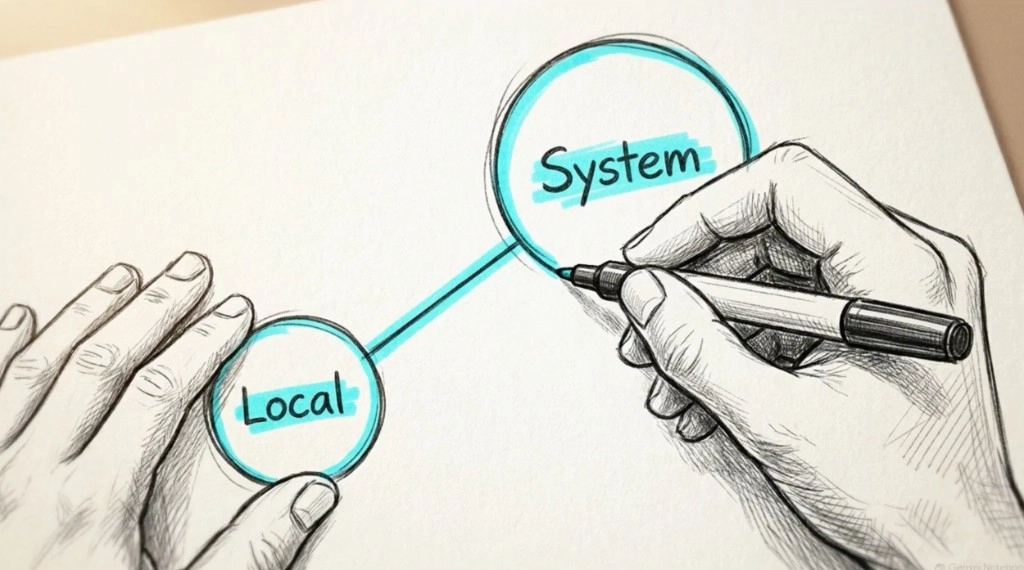
AI lets more people, and more and more agents, do more kinds of work, faster. That’s the opportunity. The risk is a hundred fast, local solutions that don’t fit together, each with its own idea of what good looks like, its own access rights and its own blind spots.
And speed on its own isn’t progress. If an agent produces ten drafts in a minute and each one needs an hour of review, the system got slower, not faster. So I step back and look at the whole system: people, agents, data, workflows and rules.
People own the problem
People decide which problem is worth solving and whether the result is good enough. In between, agents and tools take on more of the work. AI can show more options, faster. It can’t decide which aim matters.
Paved paths with the guardrails built in
Instead of everyone working out what good looks like, we encode it once: approved data sources, templates, design patterns, access rules, and decision aids at the moment they’re needed. Then people, including non-specialists, and agents can move fast and still produce work that’s coherent and safe. Knowledge that lives in a few heads doesn’t scale. And the paths get better with every lesson from real use.
Control where it counts
I place human checkpoints deliberately: before anything irreversible, anything that leaves the organisation, and anything that affects people. Checkpoints everywhere slow everything down and end up rubber-stamped.
Fast doesn’t mean shallow
Routine work flows through the paved paths. The most important problems still get deep design thinking, now with more options, quicker tests and faster learning.
One zoom out
Before solving, one step back: what am I assuming? Is this the right problem, and would solving it once help others too? Then move. Questioning shouldn’t become a reason to stand still.
People set the direction. Paved paths let people and agents move fast. Checkpoints keep it safe.
Where I’ve done this
- Bundesdruckerei: turned AI rules into decision aids that work at the moment of use, designed especially for non-technical staff. Guardrails built in, not memorised.
- i-Kfz: accessibility built into the design system at component level, so every new screen was accessible by default.
- EquitAI: human oversight built into the data model. Every AI suggestion carries a status and a label showing who wrote it.
- Systems Thinking
- Agentic AI
- Human Oversight
- AI Adoption
- AI Governance