Trust + responsibility
When the AI Thinks the Burglar Is the Cat
Accuracy isn't enough. We need to understand which mistakes matter.
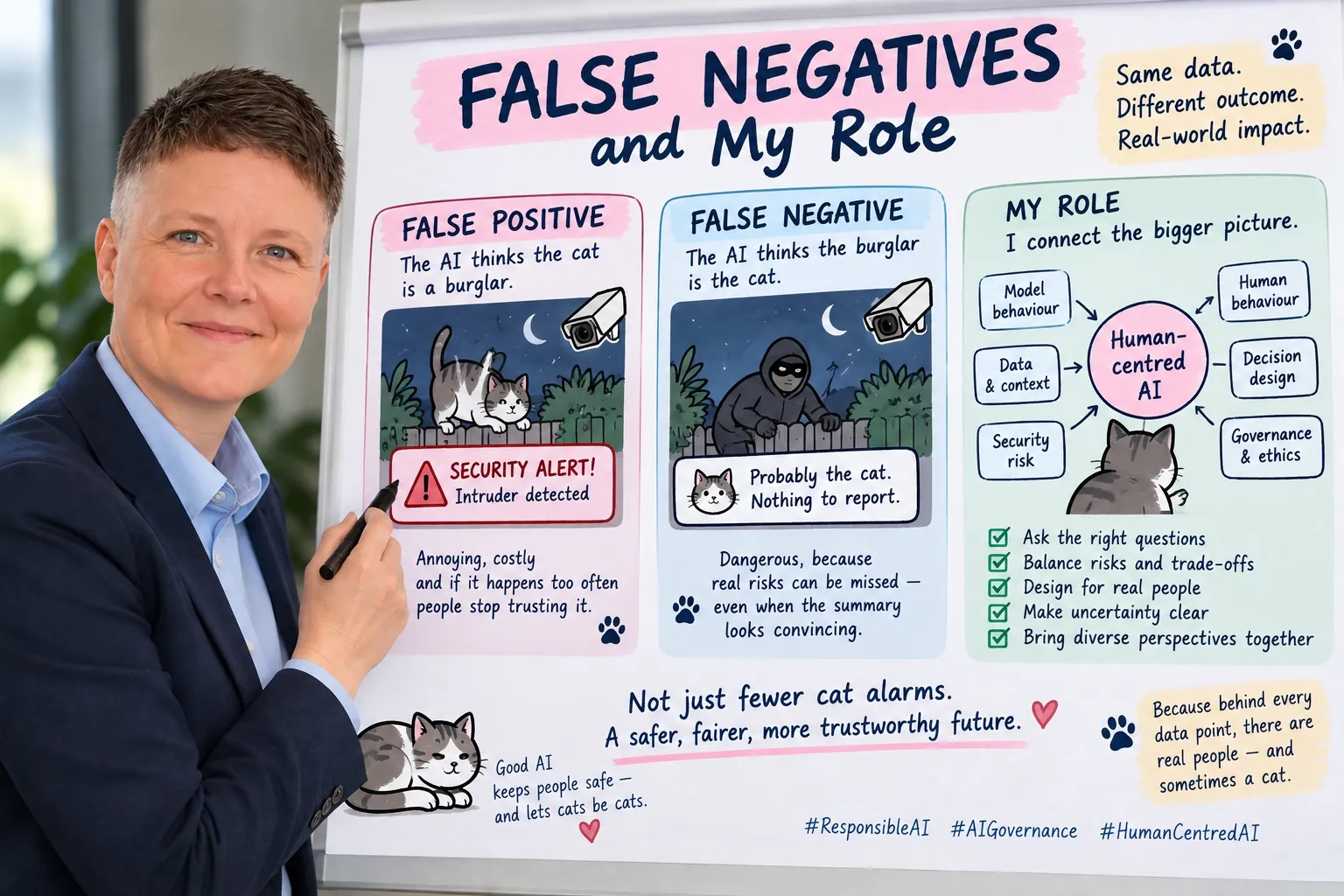
Imagine an AI-powered security system.
A cat walks past the house.
The AI decides:
Burglar.
That’s a false positive.
It’s irritating. Maybe expensive. And if it happens often enough, people stop trusting the system.
Now reverse it.
A burglar approaches the house.
The AI decides:
Probably the cat. Nothing to report.
That’s a false negative.
Same system. Same type of classification problem.
Very different consequence.
This is one of the reasons I find the human side of AI so important.
We often discuss AI performance through numbers: accuracy, precision, recall, benchmark scores.
But humans don’t experience a benchmark.
They experience the consequence of a decision.
And different mistakes carry different consequences.
The same question appears when AI summarises information.
A summary can look fluent, convincing and perfectly reasonable while leaving out the one piece of information that actually matters.
The problem isn’t always that AI invented something.
Sometimes the problem is what disappeared.
That changes the design question.
Instead of asking only:
How accurate is the model?
we also need to ask:
What happens when it is wrong?
Which kind of error matters most here?
Who experiences the consequence?
Can they recognise that something is missing?
Can they challenge the result?
When should a human remain involved?
For me, this is where Human-Centred AI becomes important.
I am interested in the whole chain:
- Model
- Information
- Interface
- Human
- Decision
- Consequence
My role isn’t to optimise the model.
It is to connect the bigger picture around it: model behaviour, data and context, security risk, human behaviour, decision design, governance and ethics.
Because behind every data point there may eventually be a real person.
And occasionally, a cat.
- Human-Centred AI
- Responsible AI
- AI Risk
- Decision Design
- Human Oversight